






Link copied

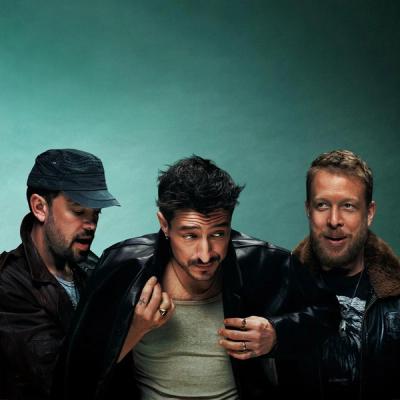
It might sound like an outrageous, ridiculous and even laughable idea to suggest that one of the poster boys for modern folk music, Mumford & Sons, are not making folk music.
The British trio - consisting of Marcus Mumford, Ted Dwane and Ben Lovett - are widely hailed as the founding fathers of the contemporary folk sound, with virtually all of today's leading folk artists, from Noah Kahan to The Lumineers to Hozier, credit Mumford & Sons as being pivotal influences when they were finding their own style.
But as you listen to Prizefighter, the trio's 2026 studio album, and watch footage of the group performing with the likes of Lainey Wilson, Shania Twain, Darius Rucker and Old Crow Medicine Show, and as you hear all three band-members speak about their love of country music while promoting ‘Here’ with Chris Stapleton, there's a dawning realisatio they've been trying to tell us that we've missed something.
Prizefighter, for all intents and purposes, could be considered a country album.
And the deeper you delve into the sonics, the foundation, the collaborators and all the threads that bind this wonderful project together, the more this preposterous idea that Mumford & Sons might be making country music feels, well, credible.
‘Here’, with Chris Stapleton, is unsurprisingly already accepted as a country song and is being played on Country Radio. But if you listen to ‘The Banjo Song’, a bright, hopeful ode that revolves around the eponymous instrument, feels like a soaring country anthem you'd hear played around the campfire at a tailgate party. Aside from the banjo, there are the subtly twangy guitar flourishes and the sleek harmonies. If you imagine Marcus’ British accent being replaced by a heavy Southern drawl, ‘The Banjo Song’ could easily be a Florida Georgia Line earworm.
‘Begin Again’ and ‘Stay’, meanwhile, ooze country-rock angst and visceral, natural-landscape-inspired imagery. And ‘Badlands’ - the beautifully drawn-in gem, with Gracie Abrams’ ethereal vocals fluttering in and out - puts the stellar harmonies front-and-centre. There are also, of course, the subtle spiritual undertones we regularly hear in country, epitomised on ‘Begin Again’, ‘Rubber Man Man’ with Hozier, ‘Shadow Of A Man’ and ‘Conversations With My Son (Gangsters & Angels)’.
We've written before about Mumford & Sons’ affinity for country music, as they highlighted when they embarked on last year's Railroad Revival Tour, which effectively saw the group serving as a ‘house band’ for country artists like Wilson and Rucker.
Then there's the giddy joy that Marcus especially exudes whenever he gets the chance to work with country artists like Shania Twain at BST Hyde Park or Chris Stapleton on ‘Here’.
It's often been postulated that you are the summation of your five closest friends. If we are to look at the people Mumford & Sons have surrounded themselves with while creating Prizefighter, it's been an unquestionably country-leaning bunch.
But the key clue here is found in a blossoming sub-genre of country music, headed up by the likes of Dylan Gossett, Max McNown, Lily Fitts, Jonah Kagen and countless others.
These artists are all unanimously labelled as ‘country’, but their sound feels far closer to that of Mumford & Sons than Morgan Wallen, Lainey Wilson or Ella Langley. And many of these artists openly praise the Mumford trio as one of their core influences.
The proof is in the pudding. Gossett has been opening for Mumford & Sons throughout their 2026 Prizefighter Tour, as has country trailblazer Sierra Ferrell, who also lends her vocals to the ‘Here’ remix. Meanwhile, artists like McNown, Kagen and Fitts instinctively reach for songs by Mumford, Noah Kahan and The Lumineers when discussing their favourites, rather than classic country offerings. And you can hear it in the music, with Gossett opting for pared-down, acoustic instrumentals and yearning, stomp-and-holler choruses, while McNown builds atmospheric, yearning compositions around vibrant, folksy storytelling.
So it's a case of working backwards. If this new cohort of artists like Gossett and McNown are considered to be ‘country’, and their sound directly incorporates and borrows elements from the Mumford & Sons rulebook, then surely this means we have to entertain the idea that the ‘I Will Wait’ hitmakers are also country.
The purpose of this isn't to claim that Mumford & Sons should win Album at the Year at the CMA Awards, nor even really to argue that the trio would see themselves as country. It's more to demonstrate how malleable our concept of country music now is, and how, despite the common perception that country and folk are acres and acres apart in style and substance, in reality, they're both nestled in the same, expansive wildflower meadow - they just tend to play in different corners.
It also shines a light on how important accents have become in how we define and categorise what's country and what isn't. Wallen's producer, Charlie Handsome, has openly admitted that the mission is essentially to write Pop Radio hits, with Wallen's voice ensuring that the music is always, to some extent, ‘country’.
And by the same token, it can feel a little jarring and counterintuitive to try and label music that has a decidedly British accent as ‘country’, when we tend to conceptualise the genre as typically having a Southern, twang-infused sound. But shouldn't country be about more than an accent? Shouldn't it be about the stories and the music? And what about the Australian artists that have had success in the genre? Or the artists that aren't from ‘Southern’ states, like Zach Top and Tucker Wetmore - is their role in the genre jeopardised simply due to their hometown?
If you ignore the London accents that permeate Prizefighter, and focus instead on the rich, compelling storytelling, the strikingly intricate instrumentation, the sinuous, infectious melodies and the enchanting harmonies, the project features many hallmarks of country - or at the very least, that ever-enigmatic label, ‘Americana’.
And as we so often find with Americana, ultimately, the genre is in the eyes of the beholder, and this Mumford meditation is primarily designed to simply remind us that our musical labels can be too strict and narrow-minded. The only thing we can know for sure, in this writer's opinion, is that, whatever genre or sub-strand it belongs to, Prizefighter is a truly brilliant and boundary-pushing album that showcases Mumford & Sons’ ability to combine evocative, poetic lyricism with rousing, spellbinding hooks. Surely, if nothing else, we can agree on that.



Comments
Anyone can read the comments. You need a free account to post one.
Loading comments…
Keep it civil. Read our community guidelines.